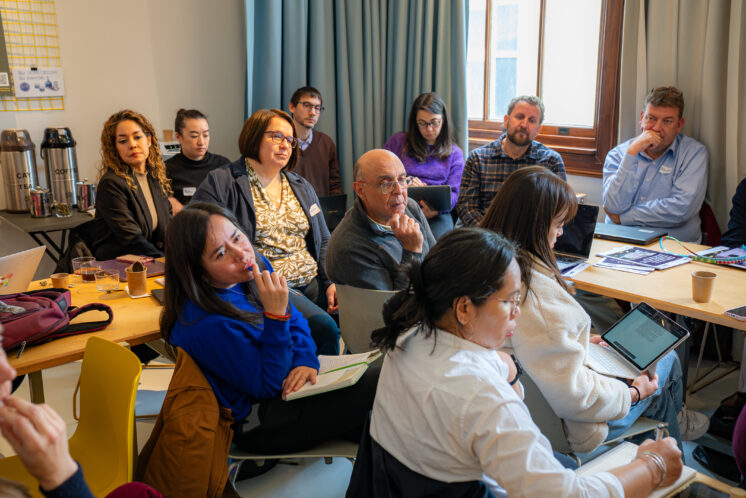
Reporting back from a busy week at the OECD!
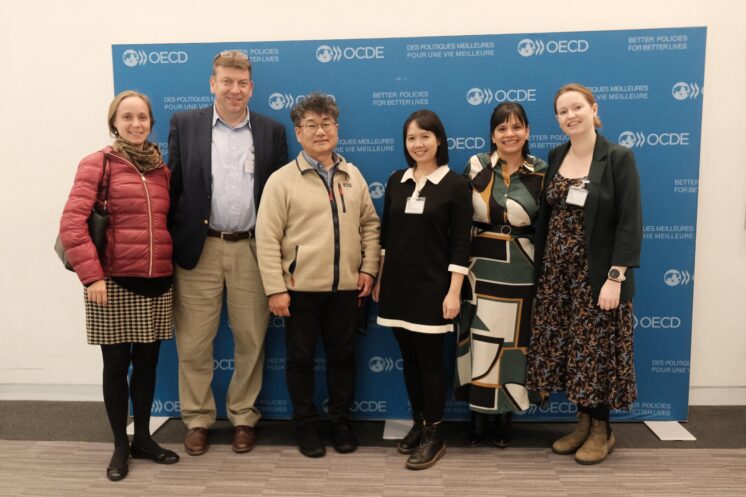
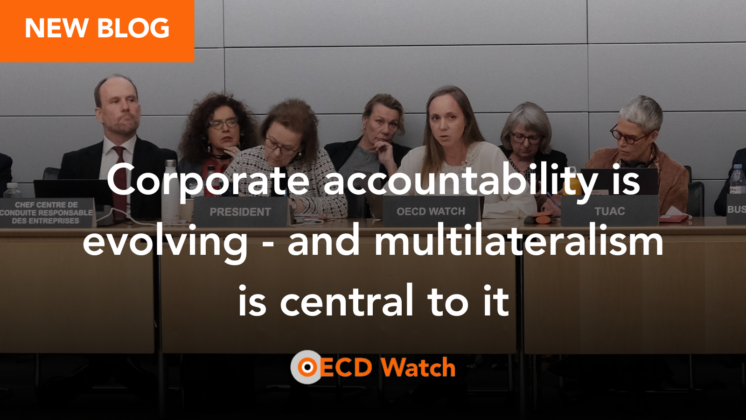
Last week a delegation of OECD Watch CSO members and partners joined three meetings at the OECD Headquarters in Paris – of the OECD Inclusive Platform on Due Diligence Policy Cooperation, the Working Party on Responsible Business Conduct, and the National Contact Point Network – to call for focus on human rights, environmental protection and climate mitigation, and prevention of harm to rightsholders. The delegation also held bilateral meetings with several governments on topics ranging from banning products made with forced labour to ensuring robust OECD guidance on the Just Transition.
Despite endorsing conservative policy in many arenas, the OECD is a leading and progressive voice on responsible business conduct. OECD Watch formally represents civil society to the committee that handles policymaking on RBC, and plays a key role in helping influence the OECD’s agenda and standards in this important space.
OECD Inclusive Platform on Due Diligence Policy Cooperation – 27-28 October
Earlier this year, the OECD launched a platform fostering global government exchange on how to legislate corporate human rights and environmental obligations and accountability. This meeting was the second iteration with attendees from 68 governments and a range of stakeholders.
The OECD kicked off by sharing a mapping comparing 21 laws on corporate accountability (including mandatory due diligence measures, disclosure laws, and trade bans or other market-based measures). The mapping highlighted areas of convergence and divergence and the discussions focused on challenges the gaps cause for companies and rightsholders alike.
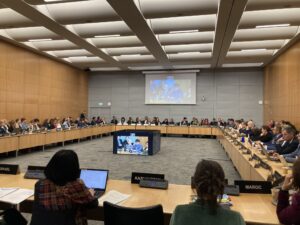
Ben Vanpeperstraete with Anti-Slavery International (UK) voiced OECD Watch’s call to improve the mapping by more clearly distinguishing which laws best align with international standards like the OECD Guidelines and UNGPs. He called for clear guidance from the OECD to governments on using the standards as a baseline in new legislation to ensure binding law always includes, for example, robust rules on providing remedy, continuously involving stakeholders, ensuring responsible disengagement, and holistically addressing climate, environment, and human rights concerns. Read our recommendations to guide future Platform meetings, here.
The second day focussed on data and reporting: how to support business partners around the world to provide supply chain data, ensure shareability and comparability across reporting requirements, and promote meaningful reporting.
JC Kim from Advocates for Public International Law (Korea) called for reporting requirements to reflect international standards. For reporting to be meaningful, indicators must require a genuine risk-based approach and detailed data on, for example, measures adopted to prevent, cease, and remediatie harm, outcomes for rightsholders of such measures, and results of stakeholder engagement. JC also urged that the next Platform meetings address stakeholder engagement, risk-based due diligence, responsible disengagement, and remedy, including by assessing due diligence laws against international standards.
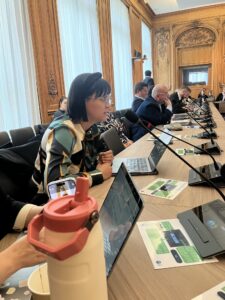 Day 2 also included a regional discussion amongst Latin American and Caribbean governments on regional collaboration in advancing corporate accountability law and policy. In this discussion, Rosa Peña of the Inter-American Association for Environmental Defense (AIDA) outlined barriers to civil society participation in RBC policymaking in the region. She called for both the OECD and states to actively promote human rights principles across policymaking, outline new parameters for sustainable business models and discourage ‘business as usual’, and systematically and meaningfully involve civil society and rightsholders in RBC policymaking. OECD Watch is urging similar inter-governmental discussions for other global regions.
OECD Watch and governments expressed strong appreciation for continuing the Platform discussions, which can foster needed progress and cooperation on binding accountability law.
Working Party on Responsible Business Conduct – 29-30 October
OECD Watch advises the Working Party on RBC at least three times a year as it promotes existing OECD RBC standards and creates new ones. At this session:
Cherry Waranya with Manushya Foundation raised important concerns over pro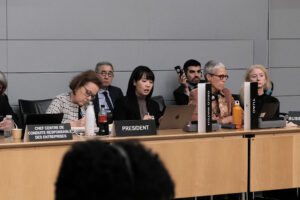 posed edits to the OECD’s forthcoming principles on the corporate role in the securing a Just Transition. She urged retention of the core terminology on “just transition” as well strengthened language on the timely phase out of fossil fuels, Indigenous Peoples rights and FPIC, and sustainable consumption and resource use by corporations. She also called for recognition of “rightsholders” and stressed that justice must remain at the core of the transition. For a year, over 60 members of OECD Watch have been working to advocate the release of robust principles next June 2026.
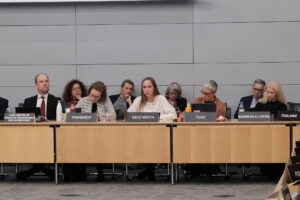
Marian Ingrams, OECD Watch secretariat staff, raised concerns about proposed changes to the OECD’s draft Due Diligence Guidance for Responsible AI. She also thanked the OECD for its work to compile a zero draft “compendium” of good government practice in promoting RBC – such as through advancing due diligence law, embedding RBC in procurement policies, and reflecting RBC in trade and investment agreements. Marian called for a more analytical approach in the next draft, explaining what makes a measure “good” or not, exploring how governments overcome challenges in adopting such measures, and tallying which governments are (and are not) taking such steps to promote RBC. The compendium is part of the OECD’s implementation of its 2022 Recommendation on the Role of Government in Promoting Responsible Business Conduct. Read our blog on how to use this important Recommendation, here.
Meanwhile, Hannah Greep, OECD Watch secretariat staff, welcomed the OECD’s plans to highlight the 50th anniversary of the Guidelines next June 2026 and outlined the network’s own plans.
National Contact Point Network – 30 October
On our last day at the OECD, we joined the regular meetings of the network of the 52 National Contact Points (NCPs) to discuss several priorities:
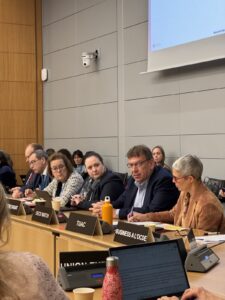
During the “open discussion” with stakeholders, JC called for specific improvements to NCPs to improve their effectiveness and “equivalence” with each other. He highlighted key indicators in OECD Watch’s NCP Evaluations, which measure NCPs against 38 key performance indicators.
Paskal Vandenbussche, representing Peru Equidad, shared OECD Watch’s views on the OECD’s draft new Model Terms of Reference for NCP Mediation.In addition to noting several improvements, he called for important additions, such as on mitigating inherent power imbalances between corporate and community parties and eliminating limitations on information-sharing across large complainant groups – particularly relevant for Indigenous communities. Stay tuned for a deeper analysis by Paskal of shortcomings in the overall TOR.
Hannah provided comments on streamlining coordination between NCPs during complaints, highlighting the importance of consulting complainants on discussions to transfer complaints from one NCP to another. She underscored how coordination between NCPs is particularly important given the wide gap between top performing NCPs and many that have never handled a complaint.
Rosa then closed at a session on responsible disengagement. She highlighted serious problems AIDA has studied from disengagement cases across six LAC countries, and said the OECD needs to use its voice and expertise to help clarify international standards on responsible disengagement to ensure companies and governments avoid and address such problems.

The delegation left feeling positive about the OECD’s commitment to continue the Due Diligence Platform and strengthen focus on ensuring alignment between binding law and international standards. We will continue to push hard for the strongest possible principles on a Just Transition, and will otherwise work to elevate civil society’s voice and promote progressive policymaking at the OECD.