OECD Watch Logo
  • Complaints
    • Stage one: Deciding whether to file
    • Stage two: Preparing and filing the complaint
    • Stage three: Coordination between NCPs
    • Stage four: Initial assessment
    • Stage five: Mediation
    • Stage six: Final statement
    • Stage seven: Follow-up
    • Other filing considerations
      • 2011 or 2023 Guidelines
      • Transparency and campaigning
      • Company responsibility for harm
      • NCP parallel proceedings
    • Filing tools & resources
  • Complaints database
  • OECD & NCPs
    • About the OECD
      • OECD Accession
    • The OECD Guidelines
      • What’s in the Guidelines?
      • OECD Guidelines update
    • National Contact Points (NCPs)
      • List of NCPs
      • Due diligence
    • NCP Evaluations
      • NCP Evaluations
      • NCP Evaluations Methodology
      • NCP Evaluations Outcomes and Analysis
    • Advisory Groups
  • News & publications
    • Subscribe to newsletter
  • About us
    • Our work
      • Research & analysis
      • Policy & advocacy
      • Training & capacity building
      • Remedy campaign
      • Brazil’s Accession
    • Mission, vision & values
    • Team
      • Coordination Committee
    • Members
    • Become a member
    • Donations
    • Contact
Filter content type
Topics
  • Strategy review
  • NCPs
  • Due diligence
  • NCP Peer Review
  • CSDDD & Guidelines Alignment
  • 2023 Update of the OECD Guidelines
Home News Page 12

Front page of publication
News / 30th June 2010

Make or break for the OECD Guidelines? OECD Watch critiques of Guidelines’ effectiveness

In the first decade of this century, governments of the Organisation for Economic Cooperation and Development (OECD) have been unable to protect workers, communities and the environment from harm caused by multinational corporations. This is…

Announcement 2010 update of the OECD Guidelines for Multinational Enterprises
News / 31st May 2010

Announcement 2010 update of the OECD Guidelines for Multinational Enterprises

With the publication of the Terms of Reference for an update of the OECD Guidelines for Multinational Enterprises the OECD has officially signaled the start of the long expected update process of the OECD Guidelines….

OECD Watch response to the Draft Terms of Reference for an Update of the Guidelines for Multinational Enterprises
News / 24th March 2010

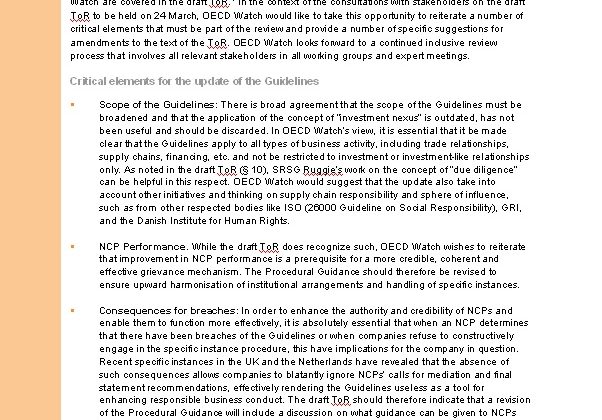
OECD Watch response to the Draft Terms of Reference for an Update of the Guidelines for Multinational Enterprises

In the context of the consultations with stakeholders on the draft Terms of Reference (ToR) for the review of the OECD Guidelines, OECD Watch has identified a number of critical elements that must be part…

Outcomes of the OECD Watch and DTP Capacity Building Seminar in Bangkok, Thailand
News / 10th March 2010

Outcomes of the OECD Watch and DTP Capacity Building Seminar in Bangkok, Thailand

At the same time as economists, researchers and government representatives met to discuss ‘Trade-led Recovery and Beyond’ at the United Nations Economic and Social Commission for Asia and the Pacific (UNESCAP) First Asia Pacific Trade…

OECD Watch Key issues for a review of the OECD Guidelines
News / 10th February 2010

OECD Watch Key issues for a review of the OECD Guidelines

The list of key issues for OECD Watch that must be addressed in a review of the OECD Guidelines are now published on the website. The key issues for which suggestions for improvement have been…

Church of England disinvests from Vedanta Resources after following up on issues also raised in OECD Guidelines complaint
News / 8th February 2010

Church of England disinvests from Vedanta Resources after following up on issues also raised in OECD Guidelines complaint

On the advise of the the Church’s Ethical Investment Advisory Group (EIAG) the Church Commissioners and the Church of England Pensions Board have sold their shares in Vedanta Resources plc. As a result, none of…

OECD Watch’s recommendations on the framework proposed by the SRSG on Business and Human Rights
News / 6th October 2009

OECD Watch’s recommendations on the framework proposed by the SRSG on Business and Human Rights

This OECD Watch paper provides a contribution to the current international debate on business and human rights, with a specific focus on the relationship between the OECD Guidelines for Multinational Enterprises and the ‘Ruggie mandate’….

News / 25th September 2009

OECD Guidelines lack teeth, influence

The OECD Guidelines for Multinational Enterprises are expectations of adhering countries with regard to responsible behaviour of their multinational corporations on Corporate Social Responsibility (CSR) issues labour and human rights and the environment. The Guidelines…

OECD Ministerial Council welcomes further consultation on the up-dating of the OECD Guidelines
News / 23rd June 2009

OECD Ministerial Council welcomes further consultation on the up-dating of the OECD Guidelines

With an open letter OECD Watch appealed to the Ministerial Council of the OECD to authorise the long-overdue review of the OECD Guidelines for Multinational Enterprises. The Council welcomes further consultation on an update of…

Front page of submission
News / 26th March 2009

OECD Watch Submission to the OECD Investment Committee

Submission by OECD Watch to the Investment Committee in preparation to the IC Working Party meetings on the 23rd and 24th of March on the Application of the OECD MNE Guidelines to the Financial Sector,…

OECD Watch Logo

Contact us

Email: [email protected]
Visit our twitter page Visit our facebook page
  • Disclaimer
  • Privacy statement
  • Cookie Policy
Cookies & Privacy
We use cookies to optimise your experience and improve our website.
Functional Always active
These cookies are required in order to use the website. They ensure that the website works properly and that your user preferences remain known. For example, they save you from having to enter the same information every time you visit our website. We may set these cookies without your consent.
Preferences
The technical storage or access is necessary for the legitimate purpose of storing preferences that are not requested by the subscriber or user.
Statistics
The technical storage or access that is used exclusively for statistical purposes. The technical storage or access that is used exclusively for anonymous statistical purposes. Without a subpoena, voluntary compliance on the part of your Internet Service Provider, or additional records from a third party, information stored or retrieved for this purpose alone cannot usually be used to identify you.
Marketing
These cookies track your online activity to help advertisers deliver more relevant advertising or to limit how many times you see an ad. Marketing cookies may share that information with other websites, organisations or advertisers.
  • Manage options
  • Manage services
  • Manage {vendor_count} vendors
  • Read more about these purposes
Preferences
  • {title}
  • {title}
  • {title}