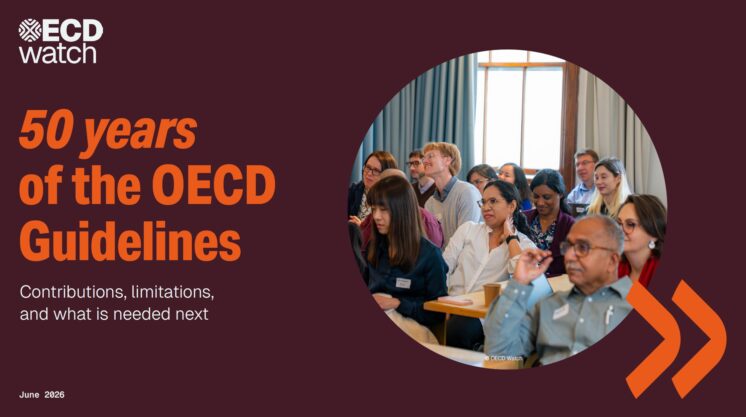
Last week, OECD Watch joined governments, businesses, trade unions and civil society from around the world in Paris for the OECD’s Responsible Business Conduct Week, marking the 50th anniversary of the OECD Guidelines for Multinational Enterprises on Responsible Business Conduct.
To mark this milestone, OECD Watch brought a diverse civil society delegation representing organisations from across Europe, Latin America and North America. Throughout the week, our delegates shared practical experience from working directly with communities affected by corporate abuse, participated in expert panels, challenged policymakers, and put forward concrete recommendations for strengthening responsible business conduct in the years ahead.
Their contributions reinforced an important message: while the OECD Guidelines have helped shape global expectations of responsible business conduct over the past five decades, the next fifty years must be defined by mandatory frameworks, stronger implementation, greater accountability and remedy for harms, resulting in meaningful improvements for people affected by corporate harm.

A strong civil society voice across the week
Our delegation contributed to discussions across the full programme, ensuring that the perspectives of rightsholders and affected communities remained at the centre of conversations about the future of responsible business conduct.
The week began at the Meeting of the National Contact Point (NCP) Network, where Hannah Greep (OECD Watch Secretariat) responded to discussions about the sharp increase in complaints received by NCPs. While recognising the resource pressures facing many offices, she cautioned against reforms that could fragment procedures across countries or create additional barriers for complainants. Instead, OECD Watch encouraged NCPs to work collectively to improve efficiency while maintaining accessibility, predictability and alignment with the OECD Guidelines’ Implementation Procedures.
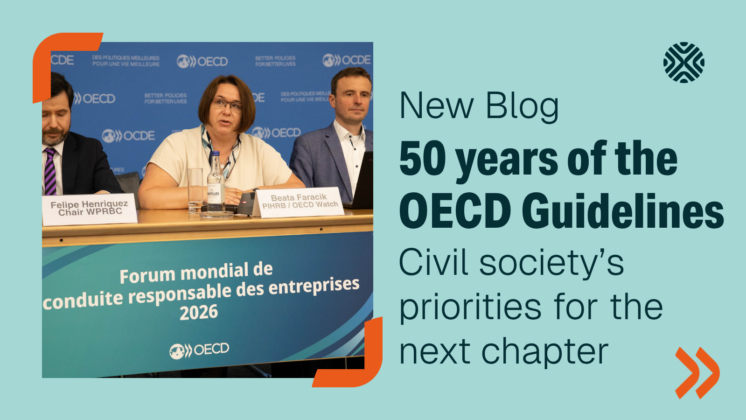
Later that day, during the NCP Symposium, Beata Faracik (Polish Institute for Human Rights and Business, Poland) highlighted that trust is the foundation of an effective NCP system. She called for governments to equip NCPs with stronger powers and resources, including the ability to issue determinations of non-compliance, recommend consequences for companies that refuse to engage, and remain central sources of expertise as governments increasingly develop mandatory due diligence legislation.

As the Global Forum on Responsible Business Conduct officially opened, OECD Watch delegates contributed across several discussions. During a session on implementing due diligence in practice, Hannah Greep challenged businesses and policymakers to move beyond making commitments and identifying risks, and instead focus on the later stages of due diligence that deliver meaningful change, including stakeholder and rightsholder engagement, harm prevention, and remediation.
Later, Giuseppe Cioffo (Clean Clothes Campaign, International Office) joined a panel on policy incentives for responsible business conduct, drawing on evidence from the garment sector to demonstrate how companies can use purchasing practices to support living wages throughout their supply chains.
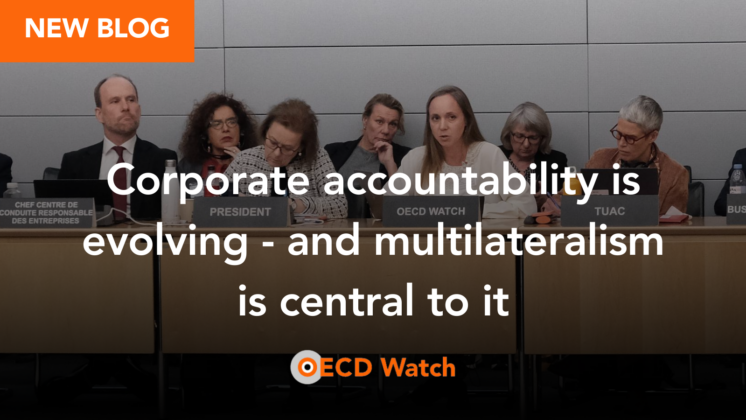
OECD Watch co-hosted a multi-stakeholder session with Business at OECD (BIAC) and the Trade Union Advisory Committee (TUAC) exploring shared priorities for the future of the Guidelines. During this discussion, Eduardo Villarreal (ProDESC, Mexico) brought powerful examples from communities seeking justice, highlighting how business-related harms disproportionately affect Indigenous Peoples, women, and human rights defenders, many of whom continue to face intimidation and violence when raising concerns.
Alongside him, Margaux Day (Accountability Counsel, United States) emphasised that access to remedy remains one of the weakest elements of responsible business conduct. She highlighted the need to strengthen NCPs by improving company participation, tracking implementation of agreements and recommendations, and ensuring that communities see meaningful outcomes from the process.

During the Inclusive Platform on Due Diligence Policy Cooperation the following day, the OECD shared new data showing that businesses are still overwhelmingly failing to conduct due diligence beyond tier one or to identify the origin of their products. Panellists discussed the value of legislation and challenges in implementation, including mapping, engagement with supply chain workers, and remediation. Gabriela Quijano (OECD Watch Secretariat) reminded governments that regulatory alignment should not lead to weaker due diligence standards, and that international human rights law requires policymakers to seek the most protective measures for rightsholders in both the design and implementation of legislation.
The subsequent breakout discussions explored different dimensions of the risk-based approach in greater depth. In one session, representatives from tech companies, the auditing industry and an expert on open data exchange in the automotive sector discussed with stakeholders about strengthening coherence and interoperability across policy approaches. A major point of consensus was that, in reporting, the principles of “do once, share with many” should apply. In the discussion, Urs Rybi (Swiss Coalition for Corporate Justice, Switzerland) built a bridge to lawmaking, emphasising how important it is to stick to concepts jointly developed in international standards when crafting legislation – highlighting how “do once, use many times” is not only smart for business, but also for policymakers.
In another session, participants discussed sustainability initiatives and their role in the emerging global due diligence architecture. The OECD highlighted the large variety of initiatives populating different sectors, and the different roles they fulfil. Both governments and businesses highlighted the difficulties of interoperability across initiatives and the importance of avoiding replacing individual due diligence obligations with membership. Giuseppe Cioffo reminded governments that when industry initiatives provide grievance mechanisms, their outcome must be binding for companies, drawing on the model of the International Accord on Health and Safety in the garment sector.

The week concluded with the Working Party on Responsible Business Conduct, where our delegation continued to engage in discussions on the future of the Guidelines, implementation of OECD due diligence guidance on artificial intelligence and minerals, and the future direction of the NCP system. Hannah Greep emphasised the need for stronger regulation, improved implementation and deeper engagement with rightsholders, while Eduardo Villarreal challenged governments to address the intimidation and reprisals that communities often face when seeking remedy. Margaux Day closed the week by identifying practical reforms that could make NCPs more accessible and effective for those seeking justice.
Three priorities for the future of the OECD Guidelines
Across every discussion, three consistent priorities emerged from the OECD Watch delegation:
1. Develop and implement strong regulatory frameworks, with the Guidelines as a baseline
For fifty years, the OECD Guidelines have shaped global expectations of responsible business conduct. Today, however, the challenge is no longer defining what responsible business conduct looks like – it is ensuring that companies actually do it.
With mandatory human rights and environmental due diligence legislation now emerging across many jurisdictions, governments have an important opportunity to build on existing international standards and put in place robust, mandatory, and enforceable regulatory frameworks. According to the OECD, around 84% of OECD member states now have some form of reporting or due diligence legislation – and many more are developing them – creating significant momentum towards a more coherent global approach.
Throughout the week, OECD Watch encouraged governments to use the OECD Guidelines as the foundation for these legal frameworks, including during the transposition of the EU Corporate Sustainability Due Diligence Directive. Aligning legislation with existing international standards will improve policy coherence, provide greater certainty for businesses, and ultimately strengthen protections for people and the environment. After fifty years of developing the standards, the priority now must be enforcing them.
2. Keep rightsholders at the centre of responsible business conduct
Responsible business conduct should ultimately be judged by whether it effectively avoids and prevents harm to people and the planet – not simply by whether companies have policies or reporting processes in place.
Our delegates consistently reminded participants that communities continue to experience severe human rights abuses, environmental damage, violence against defenders, and barriers to justice. These harms are not becoming less urgent, but in many cases are becoming more severe due to increasing pressures from the energy transition, digitalisation, and rising geopolitical conflict.
The OECD’s risk-based approach remains an essential tool for helping companies prioritise their most severe impacts. However, prioritisation should never become a reason to ignore other harms indefinitely. As the OECD’s own Due Diligence Guidance makes clear, businesses should prioritise risks where it is not feasible to address them all at once, and address the most severe impacts first before progressively moving on to the remainder.
Equally important is ensuring that rightsholders are recognised as distinct from broader stakeholder groups. According to the OECD’s research, only 8% of large companies engage with stakeholders on human rights issues, despite their commitments to responsible business conduct. Those directly affected by corporate activities are always the best source of information about how responsible business conduct is – or is not – being implemented in practice and whether it is leading to the desired results. Their experiences must continue to shape future policy development, implementation, monitoring, and evaluation.
3. Strengthen National Contact Points as engines of remedy and policy expertise
The anniversary also provided an opportunity to reflect on the future of National Contact Points. Throughout the week, our delegation emphasised that NCPs remain a unique part of the international accountability landscape. Their flexibility, dialogue-based approach, and ability to facilitate remedy make them unlike any other grievance mechanism.
However, they must also evolve. Governments should ensure NCPs are adequately resourced, empowered to make determinations on compliance with the Guidelines, able to recommend meaningful consequences where companies refuse to engage, and equipped with robust policies to protect complainants from reprisals.
At the same time, NCPs should continue serving as centres of expertise on responsible business conduct within governments. As countries develop mandatory due diligence legislation, NCPs have an important role to play in promoting policy coherence and ensuring new legal frameworks remain aligned with the OECD Guidelines – without losing their unique role as independent, dialogue-based grievance mechanisms.
Looking ahead
The OECD Guidelines remain one of the world’s most influential responsible business conduct standards, and this anniversary rightly celebrated their significant contribution over the past fifty years.
Our delegation left Paris encouraged by the growing recognition that implementation must now become the central priority. Governments, businesses, trade unions and civil society all have a role to play in translating the Guidelines into meaningful change.
For OECD Watch, that means continuing to advocate for stronger regulation, implementation that delivers tangible improvements for rightsholders, and National Contact Points that provide effective access to remedy.
The next fifty years should not be defined by stronger commitments alone, but by actual enforcement and stronger accountability – and by better outcomes for the communities the Guidelines were ultimately designed to protect.
Want to read more?
You can read more about OECD Watch’s priorities for the future of the OECD Guidelines, including concrete recommendations for governments, the OECD, and civil society, in our report here.
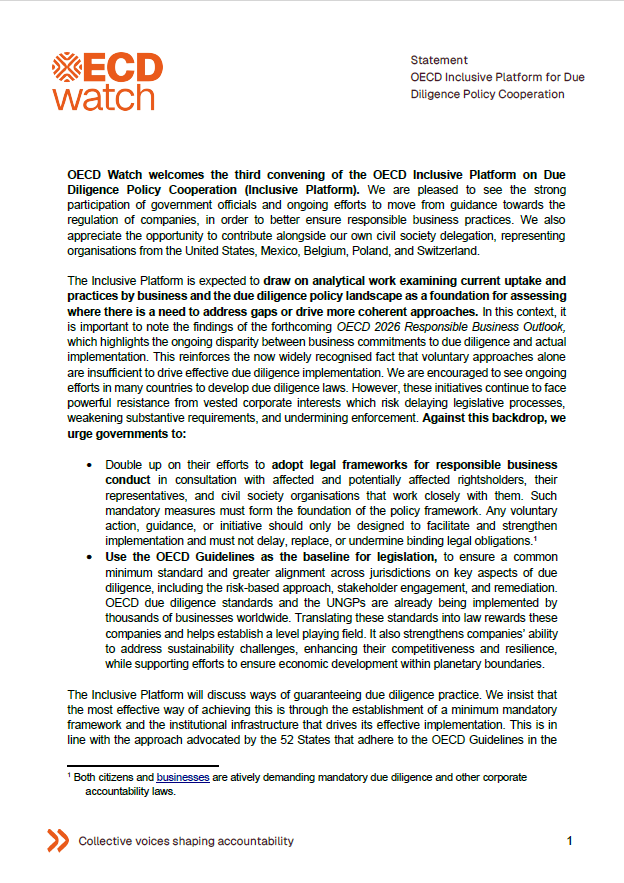
Do you want to read more about our recommendations and priorities for the OECD’s Inclusive Platform on Due Diligence Policy Cooperation? You can check out our statement here.