The European Parliament has today approved the Omnibus I package that significantly weakens the landmark Corporate Sustainability Due Diligence Directive (CSDDD), among other accountability laws. OECD Watch calls on EU Member States to correct the damage by seeking common-sense, values-driven alignment with the OECD Guidelines during national implementation. We remind Members to use the OECD’s Inclusive Platform for Due Diligence Policy Cooperation (Platform) to maximise their national impact in that process.

OECD Watch’s work on corporate accountability law
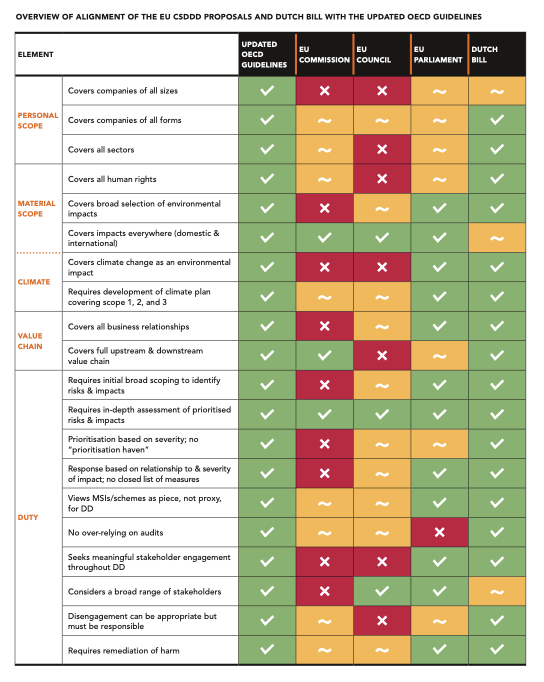
For the last several years, OECD Watch has supported civil society globally in calling for corporate accountability laws that embed, as a baseline, the core due diligence principles and processes laid out in the OECD Guidelines for Multnational Enterprises on Responsible Business Conduct and UN Guiding Principles. Our series of papers evaluating alignment between the EU CSDDD (Directive) and OECD Guidelines has provided key analysis on alignment gaps and recommendations for closing them. Through workshops and webinars co-led with civil society, unions, and progressive businesses, we have outlined the feasibility and effectiveness of sticking closely to the international norms in legislative drafting. Our LinkedIn series has highlighted progress in numerous national jurisdictions towards adoption of binding due diligence law. Meanwhile, we have also supported the OECD’s creation of its new inter-governmental Platform for exchange of best practice in writing and implementing corporate value chain due diligence law and policy.
Wins and losses in the Omnibus 1 package approved by the Parliament
In May 2024, we were broadly pleased by the EU’s adoption of a Directive setting out important new requirements for multinationals to prevent and remediate harms to the environment, climate, and people in their value chains. But we were deeply disappointed by the February 2025 introduction of the deregulatory Omnibus 1 package seeking to scale back key protections and standards in the Directive. That package, with some amendments, is what the EU Parliament has approved today.
Important wins
Despite heavy and secretive lobbying by the oil industry among other regressive corporate actors, the CSDDD survives. The law still sets important ground rules for corporate accountability, including by:
- Establishing one of the world’s first broad-based legal due diligence duties for large companies to respect human rights and the environment throughout their global value chains;
- Requiring companies to identify, prevent, cease and remediate harm to workers, communities, and the environment in the EU and abroad associated with their business activities;
- Obligating Member States to ensure full compensation for victims of corporate abuse when companies are found civilly liable, allowing those harmed by due diligence failures to obtain remedies before national courts
OECD Watch is also particularly gratified that, despite early and misguided attempts by the EU Commission and Council to weaken it, the “risk-based approach” to identifying harms across a company’s direct and indirect business partners has been preserved in the Omnibus I package approved by the Parliament. This is a significant win, ensuring closer alignment between the CSDDD and international standards on this critical issue. We are concerned, however, that limitations on companies’ ability to request risk-related information from their business partners may in practice lead them to overlook serious risks – to their own and victims’ detriment.
Serious losses
But the Omnibus 1 package as approved by the Parliament has exacted serious losses – not just for the immediate victims of irresponsible business conduct, but for businesses, the planet, and citizens of the EU and elsewhere. A few of the changes represent major departures from the OECD Guidelines:
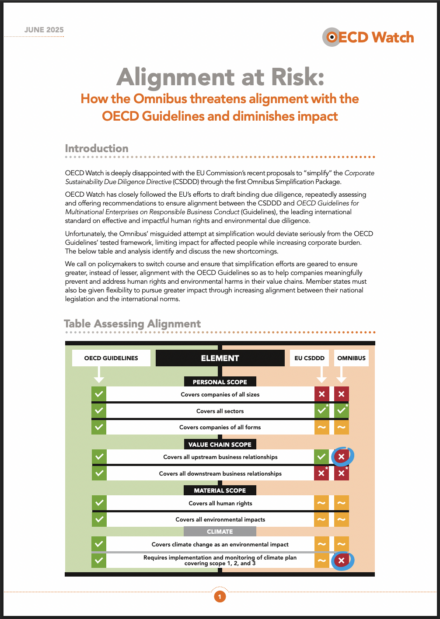
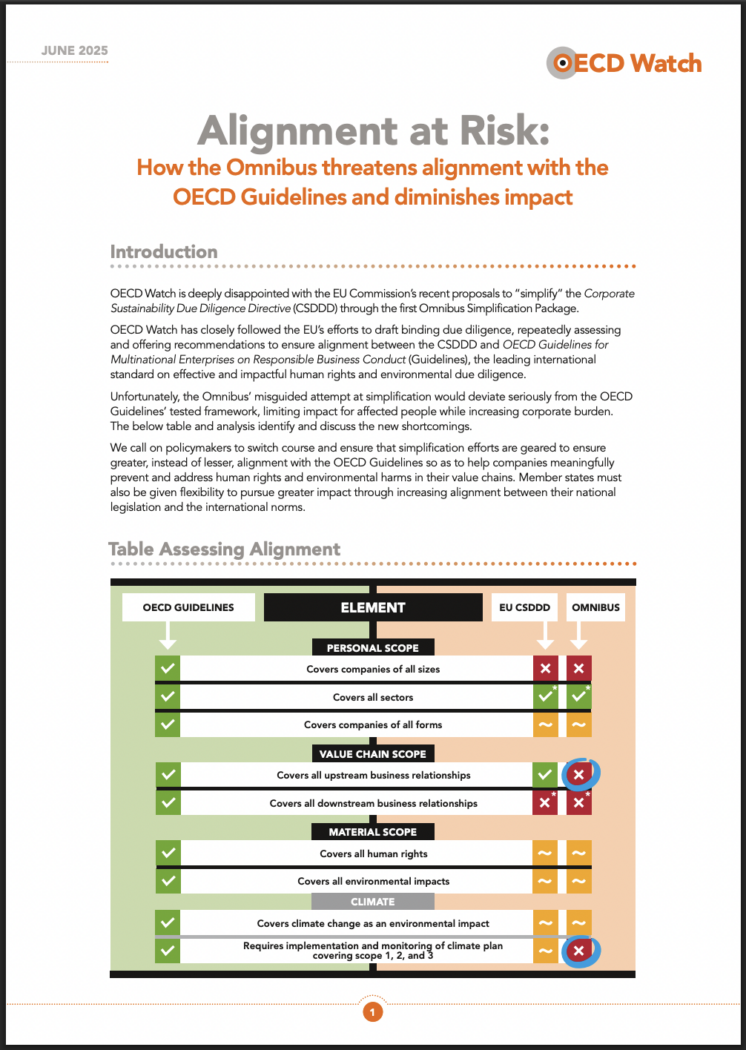
- Climate transition plans eliminated. Under the CSDDD, companies were required both to adopt and put into effect climate transition plans, with national authorities overseeing plan design and enforcing compliance with penalties where needed. In contrast with the strong climate provisions of the OECD Guidelines, the Omnibus I package now deletes all CSDDD provisions on climate transition plans. Once again, corporations have successfully led politicians to stick their heads in the sand to ignore the looming climate cliff that all citizens – especially our children – face. This cowardly and shortsighted failure stands in stark relief against the recent advisory opinions of several international courts, which have clarified the State duty to avoid climate-related harm, including by requiring due diligence from companies to address their own climate impacts.
- Stakeholder engagement diluted. Under the CSDDD, companies had to consult a broad array of stakeholders (including employees, consumers, environmental civil society organistions, and national human rights institutions) at key stages of the due diligence process. The Omnibus I package now excludes important groups such as consumers and CSOs from the definition of “stakeholders” and exempts companies from consulting stakeholders on the key due diligence topics of disengagement and monitoring. These changes strip away the voice of those most harmed by business activities, and risk undermining the overall effectiveness of the due diligence process.
- Irresponsible disengagement: The CSDDD and OECD Guidelines expect, as a last resort, a company to terminate a business relationship that is resulting, despite the company’s best mitigation efforts, in severe human rights or environmental abuse – like forced or child labour. The Omnibus I package removes this termination obligation. It also removes a requirement to consult stakeholders when companies take the preliminary step of suspending a risky relationship, despite the potential impacts of that suspension on affected workers and communities. Even worse, companies are shielded from liability or penalties when they continue to engage with business partners that violate human rights or harm the environment.
Other concerning amendments made by the Omnibus 1 package as approved by the Parliament will diminish access to justice for victims of irresponsible business conduct. Of note:
- No EU-wide framework for civil liability. The Omnibus 1 eliminates CSDDD provisions requiring consistent civil liability rules across the 27 EU States for companies that failed to comply with due diligence requirements, yielding harm to people or the environment. Now, a fragmented patchwork of liability rules may encourage a race to the bottom by companies while complicating victims’ access to EU courts.
- Fines capped at 3% of global turnover. The Omnibus 1 caps penalties at 3% of global turnover, instead of the 5% set under the CSDDD.
How to rectify the damage of the Omnibus 1
Lawmakers ostensibly sought, through the Omnibus 1 package, to cut compliance burdens for businesses affected by the law. Unfortunately, they were misled by corporations that have a vested interest in maintaining the status quo, to the detriment of our economies and societies, the planet, and our children’s futures.
In fact, data increasingly counters claims that compliance with due diligence obligations is very costly at all. To quote a major multinational speaking under Chatham House Rules to EU and other governments at the most recent OECD Due Diligence Platform meetings, “If you think compliance is expensive, try non-compliance!” This view is shared by so many companies that supported the CSDDD. Global governments have long agreed that climate change is real, slavery wrong, and pollution and biodiversity loss untenable. Sensible policymakers also know that business and social rewards will accrue to the companies that are enabled, by smart national legislation and regulation, to be “first-movers” in innovating new business models that fit within planetary needs. Sustainable business is genuinely achievable, if governments will set up the frameworks to let it happen.
Key corrective actions at national level
Member States have more than two years to incorporate the CSDDD into national law before the July 2028 deadline. Crucially, they can still correct the damage done in Brussels. This will require common-sense, values-driven political leadership that protects people and planet alongside sustainable development. Here are some key improvements needed:
- Help companies plan for future climate realities by requiring them to adopt and implement climate transition plans, and empower supervisory authorities to monitor compliance;
- Foster wider company innovation towards sustainable development by lowering employee and turnover thresholds for companies covered by the law, so that more businesses are required to conduct due diligence;
- Ensure meaningful engagement with all stakeholders minimally identified under the international standards, across all core steps and decisions of the due diligence process;
- Ensure robust civil liability provisions that are of overriding mandatory application for CSDDD-related claims, to ensure that companies can be held accountable and victims can obtain effective remedies.
Maximising national impact through the OECD’s Due Diligence Platform
Collective action is stronger, and countries around the world are already making progress on corporate accountability law. Nearly 70 governments – far more than the 52 that formally follow the OECD Guidelines – are keyed into the OECD’s new Platform to guide state cooperation in advancing due diligence law and policy. Next goals for the Platform include establishing shared approaches to key due diligence concepts such as the risk-based approach, responsible disengagement and stakeholder engagement, in alignment with international standards, and building and sharing data and evidence on the uptake and impact of due diligence policies and practices by companies and governments. We encourage governments to work with and through the OECD to collectively adopt binding laws that align with the tested standards of the OECD and UNGPs.