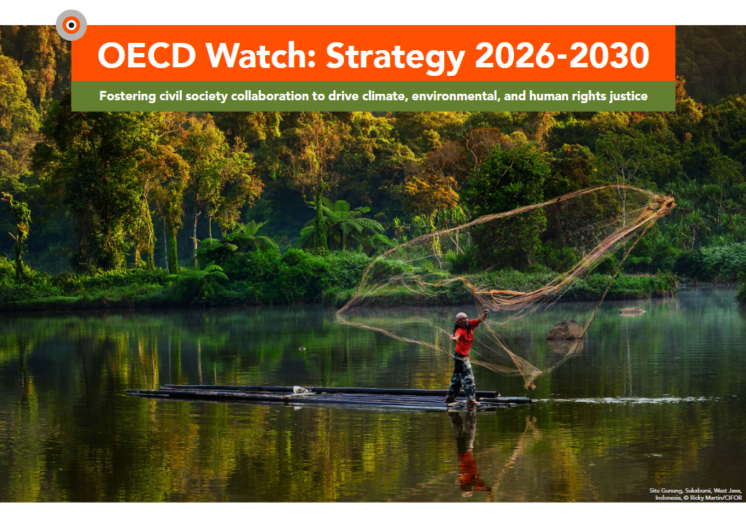
Last month OECD Watch released its new five-year strategy. The team had to laugh while writing it: in the last ten years, has there been a more unpredictable geopolitical moment in which to attempt to plan for the future? Many in our field are panicking. Forget corporate accountability – what’s happening to respect for the international rules-based order? And what role will multilateral institutions like the UN and OECD play if they are denigrated, detoured, or defunded? A sensible question for an NGO with “OECD” in its name.
Call us optimists (proudly so), but we think neither multilateralism nor corporate accountability are dead. Let’s take them in that order.
Over the past year, threats to multilateralism and inter-State agencies and institutions – even military alliances like NATO – have been deeply jarring. They’ve been upsetting not only in their own right, but because they’ve given us a glimpse of what fragmentation could look like in practice: greater license for non-aligned governments to act with impunity; disordered scrambling by other governments to salvage the best outcome for their own State alone; and stagnation of collective progress on very real shared threats, like climate change.
But as far as we can see, none of this has prompted walk-back from the widely-held conviction that collaborative, multilateral action is still the best path forward. Quite the opposite. We see governments and stakeholders calling for recentring on collective, values-based action: consider turn-out and statements by world leaders at Davos 2026, or the declaration resulting from the G20 2025. A functioning alliance system and sturdy framework of international rules seem more essential, not less. We also sense that recent bully tactics – now even between longstanding allies – are finally galvanising an indignant, more strategic, and collective counter-response. Alliances will shift, perhaps in good ways that bring new voices and powers to the decision-making table. Multilateral bodies and practices will undoubtedly evolve. But we’re confident governments will still seek to work together to respond to new development needs.
Will they still do it via the “old” multilateral institutions? Well – take the OECD and corporate accountability as an example.
Again, call us optimistic, but we feel that the field of business and human rights has come too far for us to go backwards in this space – and that the OECD is still seen as an essential guide for policymakers and practitioners.
The actual business benefits and costs of responsible – or irresponsible – operations have simply become too well understood for any serious reversal. Governments around the world are increasingly pursuing human rights and environmental due diligence laws (as we track in our LinkedIn series) not because it’s the right thing to do (though we wish this were the main driver) but because these laws help companies manage very real operational, clean-up, reputational, and consumer confidence costs. These costs arise again and again from climate-blind, polluting, abusive, or corrupt practices in global value chains. Governments are also realising they themselves – and taxpayers – shouldn’t be left footing the bill when investments are out of line with the standards States have long recommended to companies.
The steady march from soft law frameworks to binding legislation represents a major civil society victory: our long-held aspirations are now part of consumer expectations and recognised as good business sense.
Don’t get us wrong – regressive lobbying by a few companies trapped in the status quo has been damaging and deeply disappointing. But it has also painted a false picture of wide-spread corporate opposition to binding law in this space. In fact, a far broader, quieter truth prevails: many, many companies including investors are closely familiar (unlike some policymakers) with the costs of poorly managed climate and human rights impacts, and they want legal rules to help them avoid these. They want their trading partners to receive support, making their own implementation easier. And they are actively asking governments and the OECD for help.
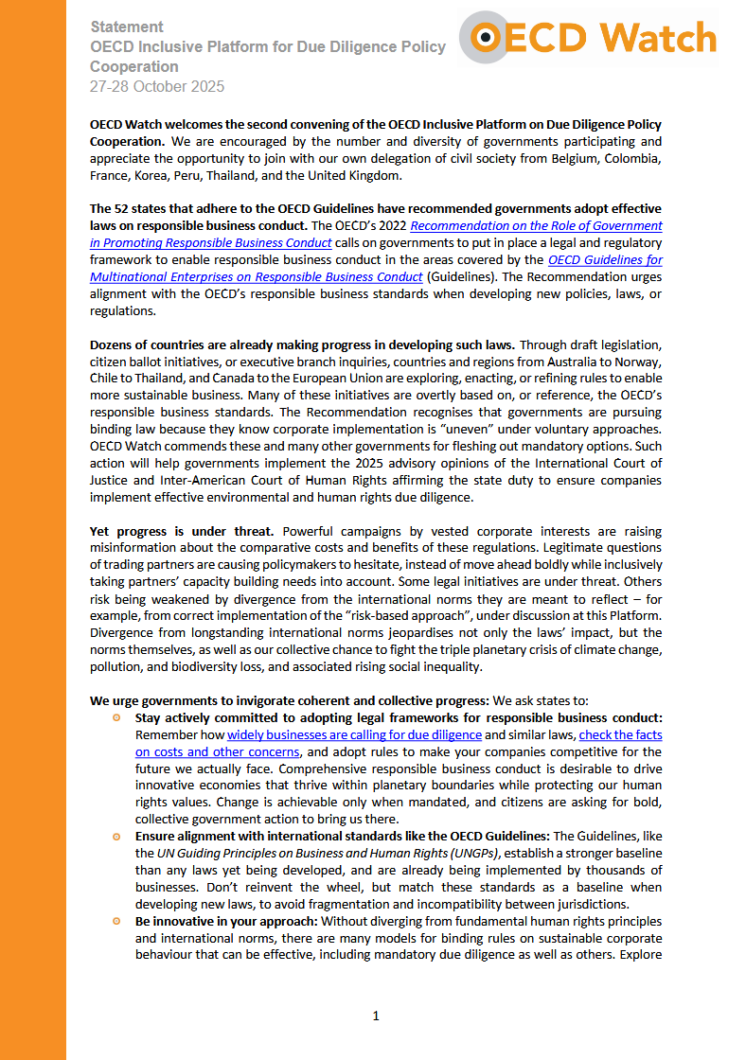
And the OECD is responding. Through its new (and securely government-funded) Inclusive Platform for Due Diligence Policy Cooperation, some 70 governments (and counting) are proactively doubling down on sharing best practices and practical experience to design and implement effective due diligence policies and laws. Simplification is now companies’ big goal. In our view, simpler rules aren’t weaker ones – but streamlined and more effective ones. Helpfully, civil society, companies, and policymakers alike see alignment with familiar international standards like the OECD Guidelines and UN Guiding Principles as an effective common denominator. And the OECD is incorporating these standards into its wider work.
Undoubtedly, serious challenges lie ahead in both the economic and political sphere. Some will stem from the human rights, environmental, and social harms of climate change. Others will come from the economic and societal disruptions of poorly managed transitions – whether to a low-carbon economy or an AI-driven one, to name just two future threats. We believe most governments really do grasp the need for a just green transition and careful management of the risks of AI, among the multitude of other global issues we face. We also appreciate that governments are turning to the OECD to help them address the corporate role in the process.
In this context, then, the OECD Watch network’s role remains clear: governments won’t get it right without hearing the experience and priorities of impacted people and civil society. Ensuring these voices are heard – in the halls where influential policy is very much still being made – will be a core part of our work over the next five years. Despite the shocking moment we find ourselves in, it’s work that leaves us not demotivated, but energised to continue turning the enduring potential of collective action into real, tangible progress.