OECD Watch Logo
  • Complaints
    • Stage one: Deciding whether to file
    • Stage two: Preparing and filing the complaint
    • Stage three: Coordination between NCPs
    • Stage four: Initial assessment
    • Stage five: Mediation
    • Stage six: Final statement
    • Stage seven: Follow-up
    • Other filing considerations
      • 2011 or 2023 Guidelines
      • Transparency and campaigning
      • Company responsibility for harm
      • NCP parallel proceedings
    • Filing tools & resources
  • Complaints database
  • OECD & NCPs
    • About the OECD
      • OECD Accession
    • The OECD Guidelines
      • What’s in the Guidelines?
      • OECD Guidelines update
    • National Contact Points (NCPs)
      • List of NCPs
      • Due diligence
    • NCP Evaluations
      • NCP Evaluations
      • NCP Evaluations Methodology
      • NCP Evaluations Outcomes and Analysis
    • Advisory Groups
  • News & publications
    • Subscribe to newsletter
  • About us
    • Our work
      • Research & analysis
      • Policy & advocacy
      • Training & capacity building
      • Remedy campaign
      • Brazil’s Accession
    • Mission, vision & values
    • Team
      • Coordination Committee
    • Members
    • Become a member
    • Donations
    • Contact
Filter content type
Topics
  • Strategy review
  • NCPs
  • Due diligence
  • NCP Peer Review
  • CSDDD & Guidelines Alignment
  • 2023 Update of the OECD Guidelines
Home News Page 7

News / 30th March 2020

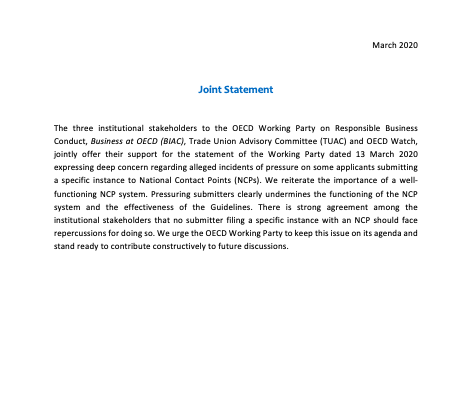
OECD Watch, BIAC and TUAC issue joint statement on reprisals

Statement supports the OECD Working Party on Responsible Business Conduct’s recent censure of reprisals against submitters of specific instances. On 30 March 2020, the three institutional stakeholder advisors to the OECD Investment Committee issued the following joint…

News / 10th June 2019

Human rights defenders face reprisals. Here’s what OECD and National Contact Points can do to protect them

A new Factsheet from OECD Watch and BHRRC sheds light on the risks to defenders who complain to OECD National Contact Points and how to reform the system to keep them safe. View the Factsheet…

News / 14th February 2019

The true cost of the Stiegler’s Gorge hydropower project in Tanzania

Independent hydropower expert Joerg Hartmann has written a report for OECD Watch member organisations on the Stiegler’s Gorge hydropower project in Tanzania. The report shows that this hydropower project Stiegler’s Gorge Hydroelectric Power Station (SGHPS) is…

Logo of the Australian National Contact Point
News / 10th August 2018

The Australian NCP’s new rules of procedure: concerns remain despite improvements

Following a public consultation, on 18 July 2018 the Australian NCP published new rules of procedures on complaint handling. While several of civil society’s recommendations have been adopted, many more have not been addressed. In…

News / 19th July 2018

Statement from OECD Watch and MiningWatch Canada regarding the Canadian NCP’s improper handling of the OECD Guidelines specific instance Bruno Manser Fonds vs Sakto Group

This statement highlights OECD Watch and MiningWatch Canada’s concerns with the Canadian NCP’s improper handling of the BMF vs Sakto Group specific instance. Background to this statement On May 16, 2018, MiningWatch Canada and OECD…

News / 21st June 2018

OECD clarifies expectations of business to prevent and remediate harmful impacts on people and planet

This week the OECD launched its new Due Diligence Guidance for Responsible Business Conduct (the Guidance). Due diligence has emerged as the fundamental and essential behaviour expected of any responsible business. The 2011 revision of…

News / 20th June 2018

Blog: the new OECD Due Diligence Guidance on Responsible Business Conduct

Due diligence has emerged as the fundamental and essential behavior expected of any responsible business. The 2011 revision of the OECD Guidelines for Multinational Enterprises (OECD Guidelines), which incorporated concepts from the UN Guiding Principles…

News / 18th June 2018

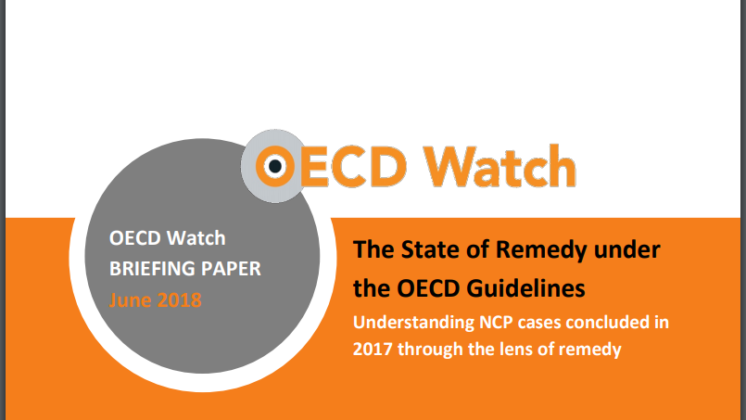
The State of Remedy under the OECD Guidelines

The OECD Guidelines for Multinational Enterprises (Guidelines) have unique potential to strengthen the global system of corporate governance and provide access to remedy for the victims of corporate misconduct. But how effective were NCPs in…

Civil society organizations call on G20 to protect human rights in global supply chains
News / 13th June 2018

Civil society organizations call on G20 to protect human rights in global supply chains

As G20 employment and education ministers meet today in Geneva, OECD Watch and civil society organizations around the globe are calling on the G20 to implement key policy recommendations in relation to responsible business conduct…

OECD Watch calls for reforms to Korean NCP to restore stakeholder confidence
News / 9th May 2018

OECD Watch calls for reforms to Korean NCP to restore stakeholder confidence

OECD Watch letter expresses concern over performance of South Korean NCP This April, OECD Watch sent a letter to the South Korean NCP and other government ministries expressing concern over the NCP’s performance. The small…

OECD Watch Logo

Contact us

Email: [email protected]
Visit our twitter page Visit our facebook page
  • Disclaimer
  • Privacy statement
  • Cookie Policy
Cookies & Privacy
We use cookies to optimise your experience and improve our website.
Functional Always active
These cookies are required in order to use the website. They ensure that the website works properly and that your user preferences remain known. For example, they save you from having to enter the same information every time you visit our website. We may set these cookies without your consent.
Preferences
The technical storage or access is necessary for the legitimate purpose of storing preferences that are not requested by the subscriber or user.
Statistics
The technical storage or access that is used exclusively for statistical purposes. The technical storage or access that is used exclusively for anonymous statistical purposes. Without a subpoena, voluntary compliance on the part of your Internet Service Provider, or additional records from a third party, information stored or retrieved for this purpose alone cannot usually be used to identify you.
Marketing
These cookies track your online activity to help advertisers deliver more relevant advertising or to limit how many times you see an ad. Marketing cookies may share that information with other websites, organisations or advertisers.
  • Manage options
  • Manage services
  • Manage {vendor_count} vendors
  • Read more about these purposes
Preferences
  • {title}
  • {title}
  • {title}